We Gave Everyone AI. Now What?
Practical Ways Registrars, Advisors, and Faculty Can Use AI in Higher Education
AI
James Abarza
6/5/20263 min read
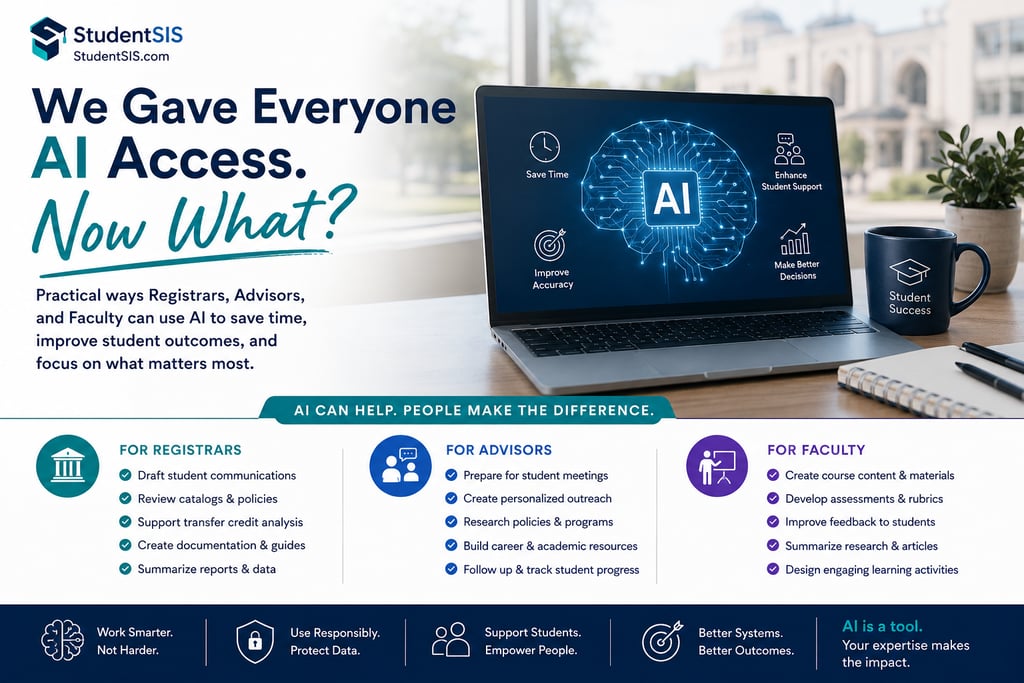
Over the past year, many colleges and universities have provided faculty and staff access to AI tools such as ChatGPT, Microsoft Copilot, Google Gemini, and other AI-powered assistants.
The initial excitement was understandable.
People tested AI by writing emails, creating meeting agendas, and summarizing documents. But after the novelty wore off, many institutions found themselves asking a new question:
"Now that everyone has AI access, what should they actually do with it?"
This is where many higher education institutions find themselves today.
The real value of AI isn't simply having access to the technology. The value comes from integrating AI into daily workflows in ways that save time, improve service, and allow staff and faculty to focus on higher-value work.
Here are some practical examples.
For Registrars: Reduce Administrative Burden
Registrar offices are often overwhelmed with policy interpretation, catalog management, transfer evaluations, degree audits, compliance reporting, and student communications.
AI can help by:
Drafting Student Communications
Registration reminders
Graduation notifications
Policy updates
FERPA communications
Academic standing notices
Creating Documentation
Process guides
Job aids
Training materials
Standard operating procedures
Assisting with Catalog Reviews
AI can compare catalog changes, identify inconsistencies, and summarize revisions for review.
Supporting Transfer Credit Analysis
AI can help summarize course descriptions and identify potential equivalencies for human review.
Preparing Reports
AI can summarize complex reports into executive-level language for leadership teams.
The goal isn't replacing registrar expertise. It's eliminating repetitive administrative work.
For Academic Advisors: Spend More Time Advising
Most advisors entered the profession to help students—not to spend hours documenting notes, reviewing policies, and answering repetitive questions.
AI can help advisors:
Prepare for Student Meetings
Upload advising notes and ask AI to create:
Meeting summaries
Talking points
Follow-up questions
Student success recommendations
Create Personalized Communication
Generate outreach campaigns for:
At-risk students
New admits
Graduating seniors
Students approaching registration
Simplify Policy Research
Instead of manually searching through lengthy policy documents, advisors can use AI to summarize information and identify relevant sections.
Generate Career Exploration Resources
AI can create industry overviews, career pathway summaries, and internship preparation materials.
The result is more meaningful student interactions and less administrative overhead.
For Faculty: Enhance Teaching, Not Replace It
Faculty concerns about AI are understandable. Many worry about academic integrity and misuse.
However, AI can also become a powerful teaching assistant.
Create Course Materials
Faculty can use AI to:
Generate discussion questions
Create case studies
Develop quiz questions
Build study guides
Improve Student Feedback
AI can help draft rubric comments and provide suggestions for more detailed feedback.
Simplify Research Preparation
AI can summarize articles, identify themes, and organize literature reviews.
Develop Active Learning Activities
Faculty can create simulations, role-playing exercises, and problem-solving scenarios faster than ever before.
The best use of AI in the classroom isn't replacing teaching—it's giving faculty more time to teach.
The Biggest Opportunity: Institutional Knowledge
One of the most overlooked opportunities is using AI to capture institutional knowledge.
Every institution has valuable expertise locked inside:
Long-term employees
Process documentation
Policy manuals
SIS procedures
Historical decisions
AI can help organize, search, and make that knowledge available to staff when they need it.
Imagine a new advisor, registrar staff member, or department chair being able to ask:
"How do we process a graduation exception?"
and instantly receive a documented institutional answer.
That's where AI becomes transformative.
Moving Beyond Experimentation
The institutions seeing the greatest return on AI are not necessarily the ones with the largest budgets.
They are the ones helping employees answer a simple question:
"How can AI make my job easier while improving service to students?"
When AI is aligned with institutional goals, student success initiatives, and operational processes, it becomes much more than a productivity tool.
It becomes a strategic advantage.
As a SIS Consultant, I work with institutions to identify practical AI opportunities, evaluate readiness, improve data governance, and ensure AI initiatives align with operational and student success goals.
The question is no longer whether staff and faculty will use AI.
The question is whether institutions will provide the strategy, governance, and guidance needed to use it effectively.