AI in Higher Education: How Universities and Colleges Can Start Using AI Today
#HigherEducation #ArtificialIntelligence #EdTech #SIS #StudentInformationSystem #AcademicAdvising #UniversityLeadership #FERPA #HigherEdIT #DigitalTransformation #AIinEducation #DataGovernance #Cybersecurity #StudentSuccess
AI
James Abarza
5/20/20262 min read
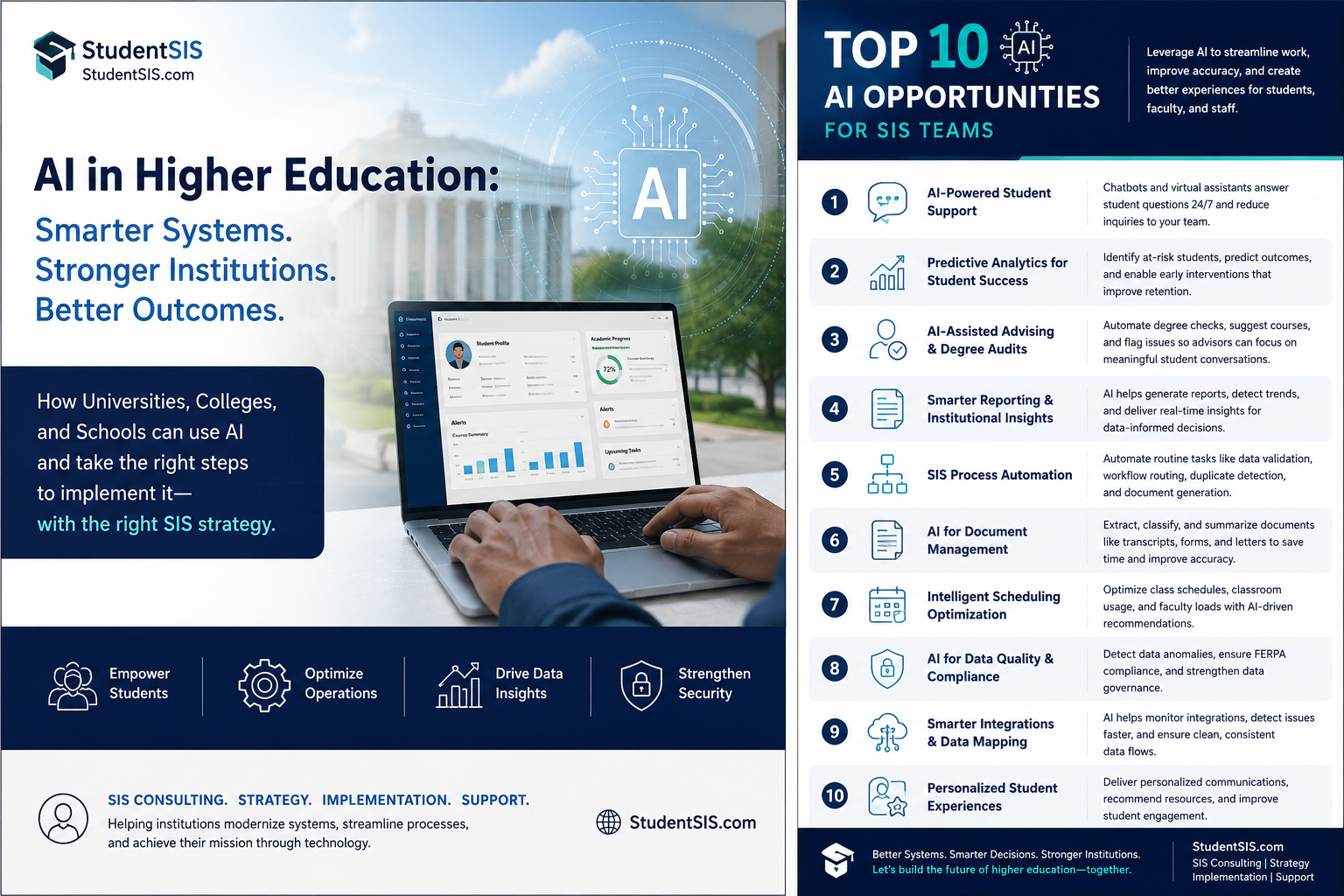
Artificial Intelligence is no longer a “future technology” for higher education — it is already transforming how universities, colleges, and schools operate.
From student support to academic advising, admissions, data analysis, cybersecurity, and Student Information Systems (SIS), institutions that begin implementing AI strategically today will gain a major advantage in operational efficiency, student experience, and institutional decision-making.
The challenge is not whether schools should adopt AI.
The challenge is HOW to implement it responsibly, sustainably, and in a way that actually supports staff and students.
As a SIS Consultant working with higher education institutions, I help schools bridge the gap between technology, operations, and institutional goals. AI should not replace people — it should empower teams, reduce repetitive work, improve insights, and create better experiences for students and staff.
Why AI Matters for Higher Education
Many institutions are facing:
Staffing shortages
Increased student expectations
Manual and repetitive processes
Data silos across systems
Reporting and compliance challenges
Budget limitations
Growing cybersecurity concerns
AI can help institutions become more proactive instead of reactive.
The key is implementing AI with a clear roadmap, governance strategy, and strong SIS/data foundation.
5 Practical Ways Schools Can Use AI Today
1. AI-Powered Student Support & Virtual Assistants
Schools can implement AI chatbots or virtual assistants to answer common student questions 24/7, including:
Registration deadlines
Financial aid questions
Password resets
Class schedules
Degree progress inquiries
Campus resource navigation
This reduces call volume and helps students get faster answers.
2. Predictive Analytics for Student Success
AI can analyze SIS and LMS data to identify:
At-risk students
Attendance concerns
Low engagement patterns
Degree progression delays
Retention risks
Institutions can intervene earlier and improve student outcomes before issues escalate.
3. AI-Assisted Academic Advising & Degree Audits
AI tools can help advisors:
Recommend courses
Identify prerequisite issues
Analyze degree progress
Detect scheduling conflicts
Suggest academic pathways
This helps advising teams focus more on student relationships and less on manual administrative tasks.
4. Smarter Institutional Reporting & Data Insights
Many schools struggle with fragmented reporting across departments.
AI can help institutions:
Summarize data trends
Generate executive dashboards
Automate recurring reports
Improve forecasting
Identify operational bottlenecks
Leadership teams can make faster, data-driven decisions with clearer visibility.
5. AI for SIS Operations & Process Automation
AI can streamline repetitive SIS tasks such as:
Data validation
Duplicate record detection
Workflow routing
FERPA-sensitive monitoring
Integration troubleshooting
Documentation generation
This allows SIS and IT teams to focus on strategy instead of constant firefighting.
Steps Schools Should Take Before Implementing AI
AI implementation should be intentional and governed properly.
Step 1: Assess Current Processes
Identify repetitive workflows, pain points, and operational inefficiencies.
Step 2: Review SIS & Data Readiness
AI is only as effective as the data behind it. Schools must evaluate:
Data quality
Integrations
Governance
Reporting structure
Security controls
Step 3: Establish AI Governance
Institutions should create policies for:
FERPA compliance
Data privacy
Ethical AI use
Cybersecurity
Staff responsibilities
Step 4: Start Small with Pilot Programs
Choose one department or process first. Measure impact before scaling institution-wide.
Step 5: Train Staff & Build Adoption
Technology alone does not solve problems. Successful AI adoption requires:
Communication
Training
Documentation
Leadership alignment
Change management
Where Can We Help Institutions
As SIS Consultants, we help institutions:
Evaluate AI readiness
Improve SIS operations
Build sustainable technology roadmaps
Streamline workflows
Improve integrations and data flows
Support reporting and governance initiatives
Coach and support institutional teams
Align technology with operational goals
AI should support institutional strategy — not create additional complexity.
Schools that begin preparing now will be in a much stronger position over the next 3–5 years.
The future of higher education will not simply be digital.
It will be intelligent, connected, automated, and student-centered.